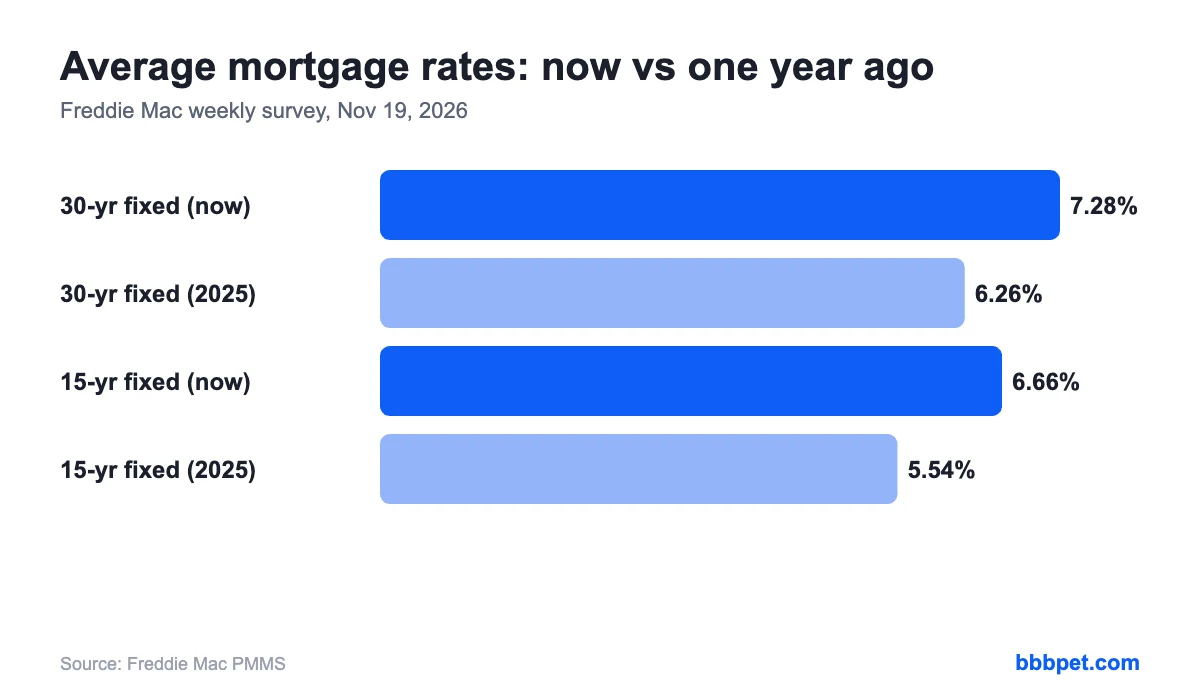
Quick answer: The average 30-year fixed mortgage rate is 7.28% and the 15-year fixed is 6.66%, according to Freddie Mac’s survey released November 19, 2026. A year ago the 30-year averaged 6.26%. Your own rate can be well above or below the average, depending on your credit score, down payment, loan type and how hard you shop.
- Rates are about one point higher than this time last year, so small savings matter more.
- Getting 3–5 quotes on the same day is the single easiest way to lower your rate.
- A credit score of 740+ and 20% down usually unlock the best pricing.
- Cutting just 0.5% off your rate can save around $40,000 on a $350,000 loan.
Mortgage rates today (November 2026)
| Loan type | Average rate | One year ago |
|---|---|---|
| 30-year fixed | 7.28% | 6.26% |
| 15-year fixed | 6.66% | 5.54% |
Source: Freddie Mac Primary Mortgage Market Survey, week of November 19, 2026. Averages assume strong credit and about 20% down. Rates change weekly — always compare live quotes.
How much does a 0.5% lower rate really save?
Here’s what a $350,000 loan costs at today’s average rate versus a rate half a point lower (principal and interest only, before taxes and insurance):
| Loan | Rate | Monthly payment | Total interest |
|---|---|---|---|
| 30-year fixed | 7.28% | $2,395 | $512,107 |
| 30-year fixed | 6.78% | $2,277 | $469,748 |
| 15-year fixed | 6.66% | $3,080 | $204,354 |
That half-point difference is about $118 a month and $42,000 over the life of the loan. The 15-year loan costs more each month but saves over $300,000 in interest compared with the 30-year at today’s average.
10 ways to get the lowest mortgage rate
1. Shop at least 3–5 lenders on the same day
Lenders price the same borrower very differently. Ask a big bank, a credit union, an online lender and a mortgage broker for a Loan Estimate on the same day, so the quotes are comparable. Multiple mortgage credit checks within a short window (generally 14–45 days, depending on the scoring model) count as a single inquiry.
2. Raise your credit score before you apply
The best rates usually go to scores of 740 and above. Pay down credit card balances below 30% of their limits (10% is better), don’t open new accounts, and dispute any errors on your reports at AnnualCreditReport.com.
3. Lower your debt-to-income ratio
Most lenders prefer a DTI under 43%, and the best pricing often goes to borrowers under 36%. Paying off a car loan or a small balance before you apply can move you into a better pricing tier.
4. Put more money down
A 20% down payment on a conventional loan avoids private mortgage insurance (PMI) and often earns a lower rate. Even moving from 5% to 10% down can improve your pricing.
5. Compare loan types
FHA loans accept lower credit scores, VA loans (for eligible service members and veterans) require no down payment, and USDA loans serve eligible rural areas. Compare the APR and total cost — not just the rate — because mortgage insurance and funding fees differ.
6. Consider a shorter term
15-year loans almost always carry lower rates than 30-year loans. If the higher payment fits your budget, it’s the fastest way to cut total interest.
7. Look at an adjustable-rate mortgage (carefully)
A 5/1 or 7/1 ARM starts lower than a 30-year fixed. It can make sense if you’ll sell or refinance before the fixed period ends — but know the caps and the worst-case payment first.
8. Decide whether to buy discount points
One point costs 1% of the loan amount and typically lowers your rate by a fraction of a percent. Divide the cost by the monthly savings to find your break-even month. If you’ll keep the loan longer than that, points can pay off.
9. Lock your rate at the right time
Once you have an accepted offer, ask for a 30–60 day lock. Ask about a “float-down” option, which lets you take a lower rate if the market drops before closing.
10. Negotiate lender fees
Use your best Loan Estimate to ask other lenders to match or beat it. Origination, application and underwriting fees are often negotiable.
What moves mortgage rates?
Mortgage rates tend to follow the 10-year Treasury yield, which reacts to inflation, jobs data and Federal Reserve policy. When inflation runs hot, yields — and mortgage rates — usually rise. Your personal rate then adds lender pricing based on your credit, down payment, loan size and property type.
Should you buy now or wait?
Nobody can reliably predict rates. A common approach is to buy when the home and payment fit your budget, then refinance later if rates fall enough (often 0.75–1 point lower) to cover closing costs. Don’t stretch your budget assuming a future refinance.
Frequently asked questions
What is a good mortgage rate right now?
Anything at or below the weekly Freddie Mac average (7.28% for a 30-year fixed as of November 19, 2026) is competitive. Borrowers with excellent credit and 20%+ down can often beat it.
What credit score do I need for the best mortgage rate?
Generally 740 or higher for conventional loans. FHA loans can accept scores as low as 580 with 3.5% down, though rates and mortgage insurance costs are higher.
Does checking rates hurt my credit?
Pre-qualification is usually a soft check. A full application uses a hard inquiry, but multiple mortgage inquiries in a short shopping window are treated as one.
How often do mortgage rates change?
Lenders can reprice daily or even several times a day. Freddie Mac publishes its national average weekly on Thursdays.
This article is for general information only and is not financial advice. Rates are national averages and change frequently; contact licensed lenders for personalized quotes.