Quick answer: A healthy 40-year-old nonsmoker can buy a $500,000, 20-year term life policy for roughly $280–$320 a year (about $23–$27 a month), based on the lowest quotes NerdWallet collected from LifeStein.com in October 2026. Prices roughly double every 10 years after 40, and smokers pay two to three and a half times more.
- Term life is the cheapest way to protect your family’s income — often 5–15× cheaper than whole life for the same coverage.
- Rates stay flat in your 20s and 30s, then rise sharply after 45.
- Your health class (preferred vs standard) can change your price as much as your age.
- A common rule of thumb: coverage of 10–12× your income, for as long as others depend on you.
Term life insurance rates by age (2026)
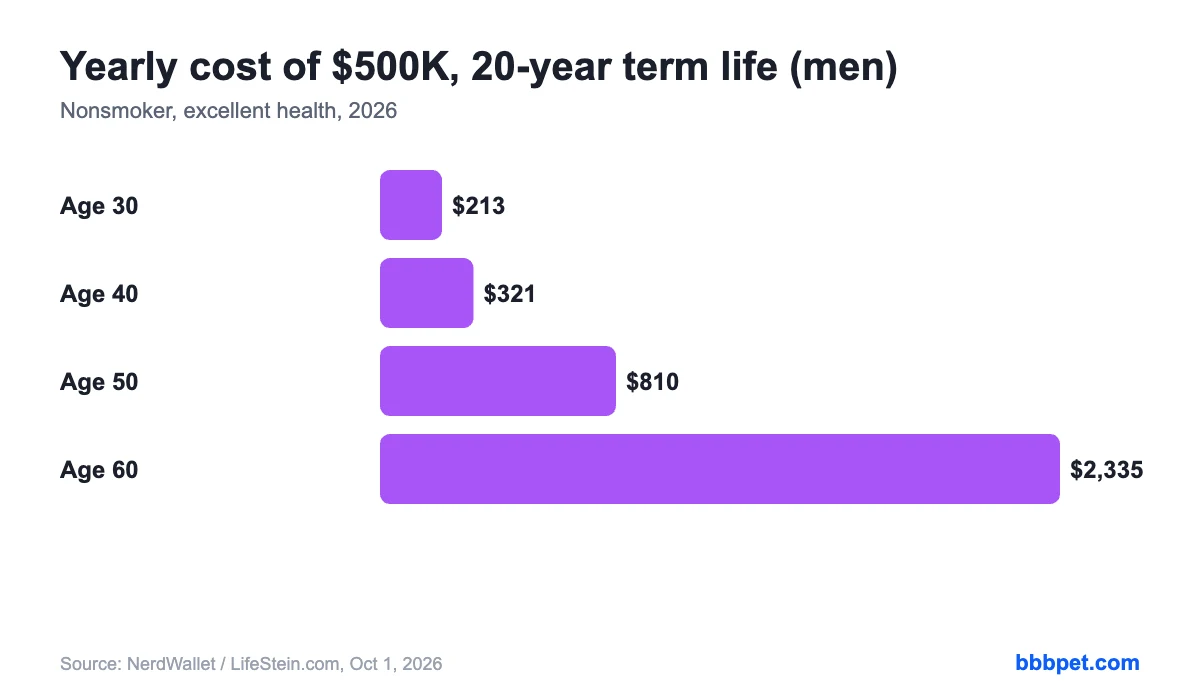
Annual rates for a $500,000, 20-year term policy, nonsmoker in excellent health:
| Age | Men (yearly) | Women (yearly) | Men (monthly) | Women (monthly) |
|---|---|---|---|---|
| 30 | $213 | $182 | ~$18 | ~$15 |
| 40 | $321 | $278 | ~$27 | ~$23 |
| 50 | $810 | $636 | ~$68 | ~$53 |
| 60 | $2,335 | $1,640 | ~$195 | ~$137 |
Source: NerdWallet, average of the three lowest LifeStein.com quotes at each age, data as of October 1, 2026. These are best-case prices; people in average health pay more — MoneyGeek’s 2026 survey found an average of $59/month for men and $47/month for women at age 40.
Why waiting costs you money
Look at the jump from 40 to 50: a man’s premium rises from $321 to $810 a year — about 2.5 times more. From 50 to 60 it nearly triples again. Because a term policy locks your rate for the whole term, buying earlier can save thousands over 20 years.
What affects your life insurance rate
- Age: the biggest factor.
- Health: blood pressure, cholesterol, BMI and medical history decide your health class.
- Tobacco and nicotine: including vaping — can multiply your rate two to three and a half times.
- Gender: women pay less because they live longer on average.
- Coverage amount and term length: more coverage and longer terms cost more, though the price per $1,000 drops at higher amounts.
- Job and hobbies: risky work, flying or extreme sports can raise rates.
Term vs whole life insurance
| Term life | Whole life | |
|---|---|---|
| Coverage length | 10, 15, 20, 25 or 30 years | Lifetime |
| Cost | Lowest | Much higher for the same death benefit |
| Cash value | None | Builds slowly, can borrow against it |
| Best for | Replacing income, covering a mortgage, kids’ costs | Estate planning, lifelong dependents |
For most families, term life covers the years when the need is biggest — while the mortgage is being paid and the kids are at home.
How much life insurance do you need?
Add up what your family would need if your income stopped:
- Years of income to replace (often 10–12× your salary)
- Mortgage balance and other debts
- Future costs such as childcare and college
- Final expenses (about $10,000–$15,000)
Subtract savings, investments and any workplace coverage. Group life through work is often only 1–2× salary and usually ends when you leave the job, so it’s rarely enough on its own.
7 ways to get cheaper term life insurance
- Buy sooner rather than later to lock in today’s age and health.
- Compare quotes from several insurers through an independent broker — insurers grade health differently.
- Quit tobacco. Many insurers offer nonsmoker rates after 12 months nicotine-free.
- Match the term to your need (e.g., until your mortgage is paid or your youngest finishes college).
- Ladder policies: combine a 30-year and a 20-year policy so coverage drops when needs shrink.
- Take the medical exam if you’re healthy — fully underwritten policies are often cheaper than no-exam ones.
- Pay annually instead of monthly to avoid modal fees.
Frequently asked questions
How much is $1 million of term life insurance?
Roughly double a $500,000 policy at the same age. MoneyGeek’s 2026 survey found a 20-year, $1 million policy averages about $109 a month for 40-year-old men and $86 for women in average health.
Can I get life insurance without a medical exam?
Yes. Many insurers offer accelerated or no-exam underwriting for healthy applicants, though rates may be higher than with an exam.
What happens when my term ends?
Coverage stops. Many policies let you renew yearly at much higher rates or convert to permanent coverage without a new medical exam.
Is life insurance payout taxable?
Death benefits paid to beneficiaries are generally not subject to federal income tax.
This article is for general information only and is not insurance or financial advice. Rates are sample averages; your actual quote depends on underwriting. Speak with a licensed agent.